NLP - Neuro-Linguistic Programming Explained
The full form of NLP is Neuro-Linguistic Programming — a practical approach to understanding how our minds, language and behaviour work together, and using that connection to change habits, communicate better and achieve our goals.
Quick note: NLP has two common meanings. In personal development and coaching it means Neuro-Linguistic Programming (the subject of this page). In computing it can mean Natural Language Processing, a branch of artificial intelligence.
Broken down
To understand Neuro-Linguistic Programming, it helps to take the name apart. Each word describes one piece of how you think, speak and act.
This part explains how your brain and nervous system take in and process information. Think of your brain as the "software" that runs your thoughts, emotions and behaviours.
Example: If you fear public speaking, your brain triggers nervousness whenever you picture giving a speech. NLP teaches you to notice and change those thought patterns so the fear loses its grip.
This concerns the power of language — both your internal self-talk and how you communicate with others — to shape your thoughts and behaviour. You learn to connect with people first, then communicate to influence them.
Example: If you often tell yourself "I'm not good at maths," that self-talk erodes your confidence. NLP helps you reframe it into "I can improve my maths with practice."
This is the idea that our behaviour runs on learned "programmes." Here you learn to rewire your beliefs, thought patterns and habits to get the results you want — dropping what doesn't work and installing something better.
Example: To stop overeating or smoking, NLP techniques help you replace the urge with a new response — chewing gum, a few deep breaths — until the healthier pattern takes over.
How it works in practice
Neuro-Linguistic Programming isn't abstract theory. It's a toolkit of practical techniques you can use in everyday conversations. Here are six of the most useful, each with a real example.
Subtly matching another person's tone, pace and body language to build trust quickly.
Example: On a call, slowing your speech to match a thoughtful buyer so they feel understood and open up.Linking a strong emotional state to a physical trigger you can fire on demand.
Example: Pressing thumb and finger together while recalling a confident moment, then re-firing it before a big presentation.Changing the meaning you give an event so it serves you instead of stopping you.
Example: Seeing a "no" from a client not as failure but as one step closer to the next "yes."Precise questions that recover the detail behind vague or distorted statements.
Example: When someone says "everyone thinks I'm no good," asking "everyone? who specifically?" to dissolve the generalisation.Stating goals in a specific, positive, self-controlled way so your mind can act on them.
Example: Turning "I don't want to be nervous" into "I want to feel calm and prepared when I present."Mentally replacing an unwanted trigger-image with a desired one to shift a habit.
Example: Swapping the mental picture that sparks a craving for a vivid image of the healthy, energetic you.Respond, don't react
Between what happens to you and what you do next, there's a gap — and in that gap lies your power to choose. Most of us react on autopilot; NLP gives you tools to pause, choose your state, and respond deliberately. That single shift changes difficult conversations, negotiations and relationships.
Why it matters
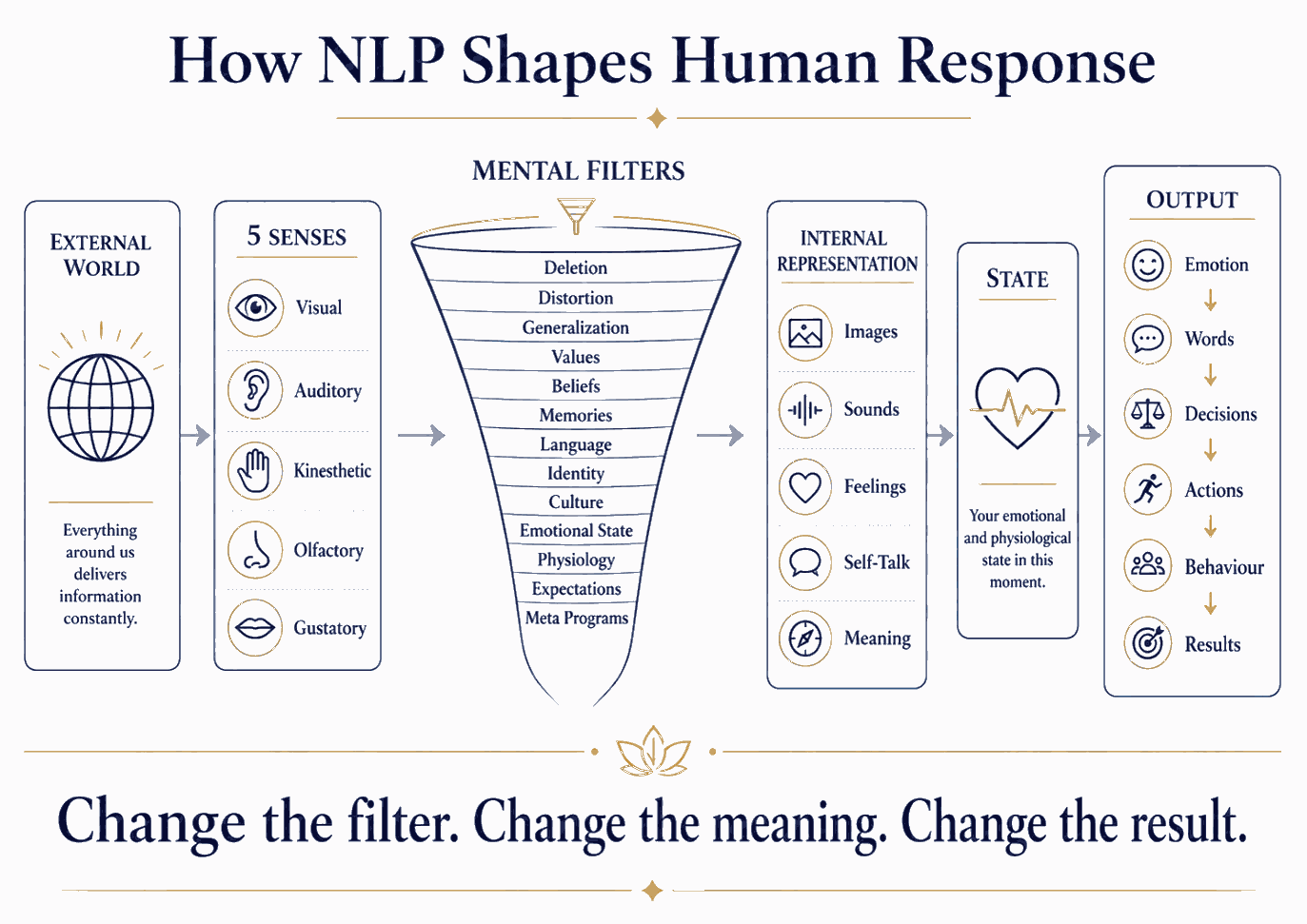
In simple terms, NLP is a set of techniques for better communication and change. In everyday life and at work, people use it to:
Put simply, NLP is a user manual for your brain — understand how mind and language interact, and you can rewire the patterns that drive your results.
NLP applied
Knowing a technique isn't the same as living it. Rajiv Sharma built the MARK Model® using NLP to solve exactly that — turning insight into habit. It stands for Mindset, Action, Repetition, Knowledge: shift the mindset, take action, repeat it until it sticks, and let reflection convert experience into knowledge. It's the engine that makes NLP change last, not fade.

Your learning path
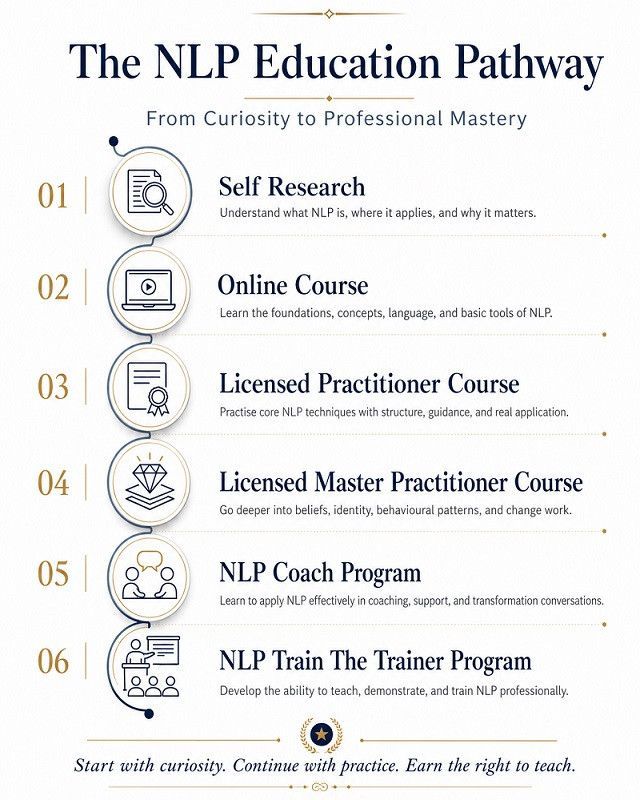
NLP is learned in stages, each building on the last. Here's the typical NLP education pathway, from beginner to master:
How it's learned
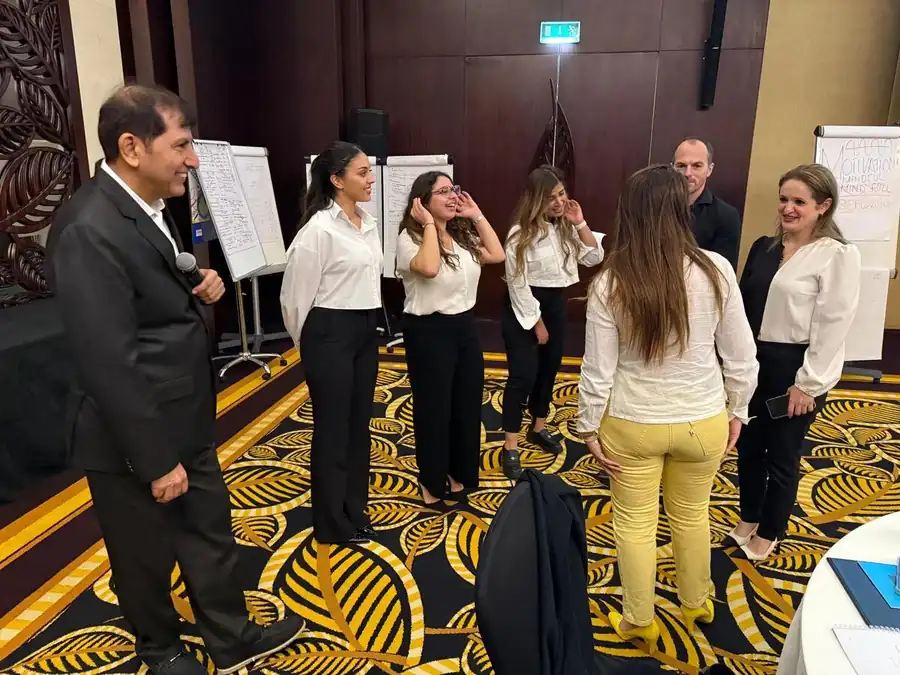
You can't master NLP from a book any more than you can learn to swim from one. It's a skill built through live practice — demonstrations, exercises with real partners, and feedback. That's why our programmes are hands-on: you practise every technique until it becomes natural.
Origins
Neuro-Linguistic Programming was developed in the 1970s by Richard Bandler and John Grinder, who studied and modelled the language patterns and techniques of highly effective therapists and communicators. It has since grown into a practical toolkit used worldwide in coaching, therapy and business.
A balanced note: NLP is a widely used practical method, and its results are experienced by many — though, like many personal-development approaches, its scientific evidence base is debated. We teach it as a set of practical tools, and let the outcomes speak.
Clearing the confusion
Because both are abbreviated "NLP," they're often confused — but they belong to completely different worlds. One is about people; the other is about machines. Here's how they compare.
| Aspect | Neuro-Linguistic Programming | Natural Language Processing |
|---|---|---|
| Field | Personal development, coaching & communication | Computer science & artificial intelligence |
| What it is | A method to change how you think, speak and behave | A technology that lets machines understand & generate human language |
| Main goal | Help people communicate, change habits and achieve goals | Help computers read, interpret and produce text and speech |
| Created / driven by | Richard Bandler & John Grinder (1970s) | The AI research field, now powered by machine learning |
| Used by | Coaches, salespeople, leaders, therapists | Software engineers, data scientists, AI products |
| Everyday example | Reframing "I'm bad at maths" into "I can improve" | Chatbots, Google Translate, voice assistants like Alexa |
| Explore at NLP Limited | Digital Marketing using Neuro Science → | How to Use AI in Sales → |
This page is about Neuro-Linguistic Programming — the human method. If you were looking for the AI term, that's Natural Language Processing.
In business & life
NLP is applied every day across business and life. Here's where NLP Limited puts it to work, with programmes you can explore:
Build rapport, influence buyers and close with confidence using NLP selling techniques.
Sales Training — India →Sales Training — UAE →Combine NLP with the ICF pathway to coach clients to real, lasting change.
ICF Coach Certification →Handle every interaction with empathy and turn complaints into loyalty.
Customer Experience Training →Lead, influence and inspire teams with emotional intelligence and NLP.
Leadership Development →Use NLP to plan your path, grow, and win the promotion you're after.
Career Coaching — India →Join a certified NLP practitioner programme and apply these tools in your own life.
NLP Upcoming Program →FAQ
In personal development and coaching, the full form of NLP is Neuro-Linguistic Programming — how the mind (neuro), language (linguistic) and learned patterns (programming) work together to shape behaviour. In computing, NLP can also mean Natural Language Processing, a branch of artificial intelligence.
No. Neuro-Linguistic Programming is a human communication and change method; Natural Language Processing is an AI technology that helps computers understand language (chatbots, translation, voice assistants). Same acronym, different fields — see the comparison table above.
Rapport and mirroring, anchoring, reframing, the Meta Model (precise questioning), well-formed outcomes for goals, and the swish pattern for habits — each a practical tool you can use in everyday conversations.
Richard Bandler and John Grinder developed NLP in the 1970s by modelling the language and techniques of highly effective therapists and communicators.
NLP Practitioner (foundation), NLP Master Practitioner (advanced tools and modelling), and NLP Trainer (teach and certify others), with NLP Master Trainer as the highest level.
Through a structured practitioner programme with a certified trainer, combining tools, live practice and coaching — NLP is a skill learned by doing. NLP Limited runs NLP practitioner and NLP + ICF programmes in India, the UAE and online, led by Rajiv Sharma, an NLP Master Trainer certified under Dr. Richard Bandler's Society of NLP.
Now you know the full form of NLP and how it works — the next step is learning to apply it. Join a certified NLP programme, or message us to find the right fit.